



Probably you’ve seen videos of robots used in the car makers factory like Tesla. You may have thought that achieving such precision requires artificial intelligence and a powerful control system. But maybe it’s not exactly like that. Using artificial intelligence in each robot would be very costly for industries. So what is the solution? The solution is to use a system that allows robots to repeatedly perform a specific motion with high precision without being controlled. Various industries have been able to create such a system using stepper motors.
How Stepper Motors Works?
A stepper motor divides each full rotation (360 degrees) into a relatively large number of steps. Therefore, they have discrete and exact movements. For example, a stepper motor with 200 steps can move precisely 1.8 degrees (360/200) per step. Stepper motors have coils that are activated and deactivated by codes and voltages sent to the motor by a controller and driver, which drives the movement of the stepper motor. In the following figure, you can see how the activation of coils can move the gear forward.

The Application of Stepper Motors
Because of stepper motors’ high precision and the need for expensive feedback systems, stepper motors are used in various industries. Let’s take a look at some of these applications.
1- Computer Applications:
One of the main applications for stepper motors is in the computer industry. In the 1980s, with the rise of PC desktops and laptops, computer companies turned to stepper motors for making disk drives and printers, and they continue to use these motors today.
Printers: Most printers use stepper motors in their structure. Laser printers, use stepper motors for paper feeding, the rotation of the photosensitive drum, and the toner agitator. In inkjet printers, which have high speed and low noise, stepper motors are used to move the print head and paper feed.
Floppy Drives: The floppy drive, once used as a computer data storage device, has become obsolete in recent years. Both sides of a floppy disk are coated with a magnetic material and housed inside a plastic cover. Stepper motors are used in the mechanism for moving the head to read floppy disks.
Hard Disk Drives (HDDs): A hard disk drive, or HDD, is a disk made of aluminum or glass coated with magnetic materials. The storage capacity of HDDs exceeds that of floppy disks. Stepper motors are used to control the HDD head’s mechanism. For every degree of stepper motor rotation, the head moves approximately 30 to 40 micrometers, allowing the head to read the bits.

2- The Application of Stepper Motors in CNC Machines:
In the past, all CNC machines used stepper motors, but nowadays, servo motors with motion feedback capabilities are also used. Servo motors offer better point-to-point control over long distances, but the major advantage of stepper motors lies in their open-loop control system and lower price. The movement of the workpiece in the 3 axes X-Y-Z can be well controlled with stepper motors. The milling cutter is also driven by a stepper motor.

3- The Application of Stepper Motors in Office Machines:
Stepper motors have become part of our daily lives, and we use them every day without even realizing it. Stepper motors are used in office machines as one of their vital components.
Copiers: In copiers, stepper motors are used to activate many mechanisms. The optical sensor in the copier uses a stepper motor to move to the appropriate position. The scanner unit in the copier also utilizes a stepper motor for movement. Stepper motors are also used in the mirror unit.
Fax Machines: Fax machines have been with us since the 1980s and are still widely used in most offices. Fax machines are used to transfer information through telephone lines. Pixels are read by a photoelectric head and converted into electrical signals. Stepper motors are used in the mechanism of this head. When receiving these signals, a pen in the fax machine prints the information on paper, and a stepper motor is used in the mechanism of this pen.

4- The Application of Stepper Motors in 3D Printers:
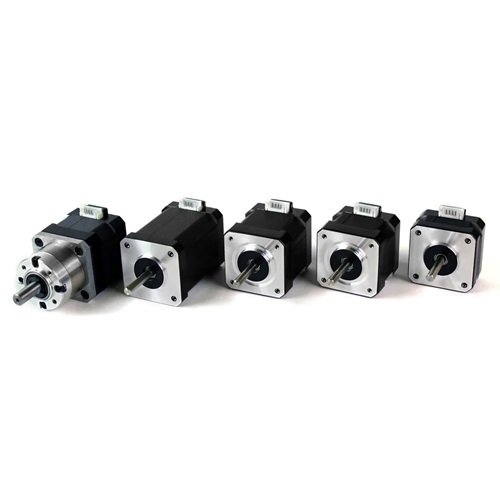
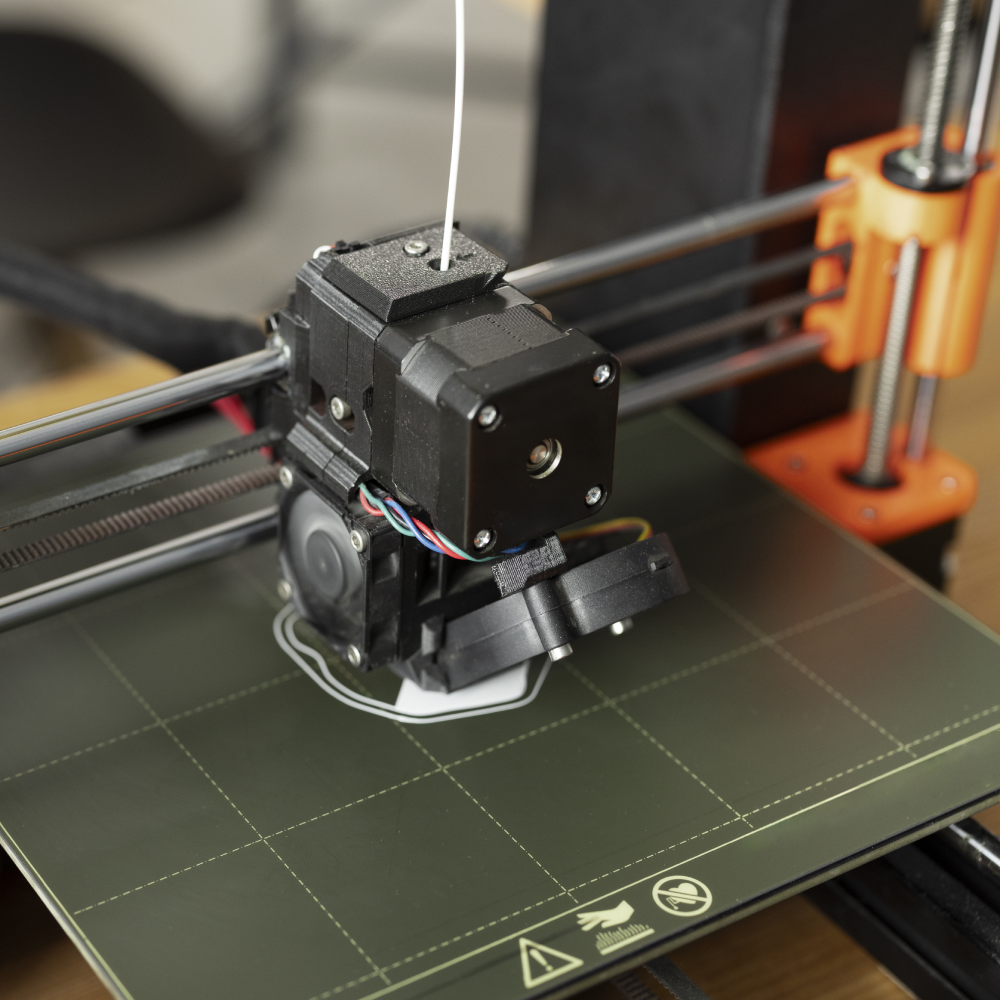
In 3D printers, stepper motors are used in the mechanism for moving the X-Y-Z axes and also in the extruder structure for filament extrusion. Therefore, commonly 4 stepper motors are used in 3D printers. Three motors are used for moving the axes, and one motor is used in the extruder structure. In common-sized 3D printers, which are 20 to 30 centimeters, NEMA 17 stepper motors with a torque of 3.5 to 5 kilogram-centimeters (kg-cm) are used.

5- The Application of Stepper Motors in the Automotive Industry:
For several years now, robots have been used instead of humans in the automotive industry to reduce costs, and this trend has increased in recent years. Robots are capable of performing a task thousands of times precisely without external control systems. This has made robots more accurate and cost-effective compared to humans. Robots are used in the automotive industry for assembly, painting, and testing of vehicles. To run these robots’ arms, a lot of stepper motors and servo motors are used.








Recent Comments